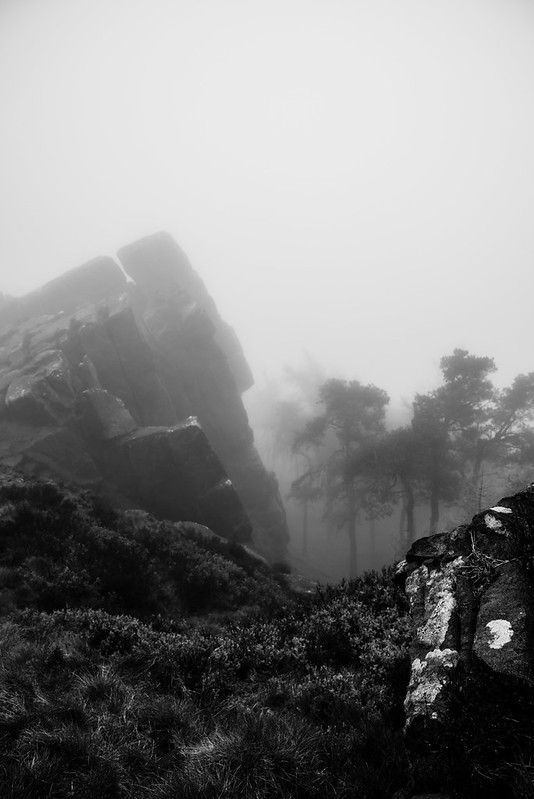
Heights & Hollows: The Shining Tor and Errwood Hall Circuit

“There is a specific kind of magic in the Goyt Valley—a place where you can stand on a sun-drenched ridge watching the ‘Matterhorn of Cheshire’ one hour, and wander through the skeletal, gothic remains of a ruined mansion the next.”


This collection documents the sharp transition from the “Eternal Skies” of the exposed moorland to the gothic, moss-drenched atmosphere of the Errwood Hall estate. The journey begins with vast, sun-baked vistas over the Cheshire Plain and the distinctive silhouette of Shutlingsloe, before descending into the sheltered ruins of a forgotten 19th-century country house.

From the stone-pitched paths of the summit to the skeletal arches of the ruins, these images capture a day defined by high-altitude clarity and the quiet reclamation of history by the forest.


The Ridge Path

The climb began with the steady pull up toward the Shining Tor ridgeline. The limestone path is a sharp white ribbon cutting through the muted tones of the moorland. From here, the “Eternal Skies” really earn their name; the horizon is dominated by the distinctive, pointed silhouette of Shutlingsloe. On a clear afternoon like this, the visibility was staggering, making every meter of elevation gain feel worth the effort.


Cheshire’s Summit Panorama

At 559m, the summit of Shining Tor marks the highest point in the county. Standing at the trig pillar, you get a full 360-degree perspective of the western Peak District. To the west, the Cheshire Plain sprawls out toward the sea, while to the east, the rugged plateaus of the High Peak roll away in waves of gritstone and heather. It’s an exposed, exhilarating place where the wind never seems to truly stop.


The Echoes of Errwood

Dropping off the high ridges and crossing through the “Forest Sentinels,” the atmosphere shifts instantly. The air grows still and cool as you enter the grounds of the old Errwood Estate. The ruins of Errwood Hall are haunting—the iconic stone arches stand like ribs against the vibrant spring greenery. Once the heart of a grand 19th-century estate, it is now a silent gallery of moss and memory, slowly being reclaimed by the ancient woodland.


Moss & Memory

The final leg of the walk winds through the deep, shaded woods near the reservoir. Here, the focus shifts from the macro views of the peaks to the micro textures of the forest floor. The gnarled, twisted branches of the oaks are carpeted in thick, emerald moss, creating a natural cathedral-like atmosphere. It’s the perfect, quiet bookend to a walk that started on the wild, sun-baked heights of the tors.


Behind the Images

  • Location: Goyt Valley, Shining Tor, and Errwood Hall ruins.
  • Conditions: High-altitude clarity with shifting cirrus clouds and intermittent bright sun.
  • Focus: Using the leading lines of the ridge paths to contrast with the framed, architectural shots of the ruins.
  • Note: The high-contrast edit on “The Looming Peak” was designed to capture the moody energy of the clouds passing over Shutlingsloe.

Walk Summary — Shining Tor & Errwood Circular

  • Distance: 11.2 km / 7 miles
  • Elevation Gain: ~380m
  • Duration: 3.5 – 4.5 hours
  • Difficulty: Moderate (Clear paths, but the ridge is very exposed)
  • Start Point: Cat & Fiddle
  • Route Type: Circular

Gritstone & Bluebells: A Summer-Like Circuit of Mount Famine

“There are days where the Peak District sheds its moody reputation and trades the mist for a relentless, wide-open heat.”


Between the deep, shaded silence of the Kinder Estate and the sun-scorched heights of Mount Famine, the sky told its own story. A vast canopy of deep azure, brushed with high, wispy cirrus that mirrored the limestone paths below—a 10km journey through a landscape caught between the intimate bloom of the woods and the infinite reach of the High Peak.


Woodland Sanctuary

Woodland Sanctuary
A vibrant carpet of bluebells near the start of the 10km circuit at Bowden Bridge. The soft spring light under the canopy is a quiet prelude to the exposed gritstone heights ahead.

The journey began at Bowden Bridge, but the true start felt like stepping into Bluebell Wood Nature Reserve. Before the heat of the day could take hold, I found myself in a shaded sanctuary. The woodland floor was a vibrant, temporary sea of violet-blue, glowing where the intense sunlight managed to pierce through the fresh spring leaves. On a day that would become punishingly hot, these quiet, shaded miles through the reserve were a luxury—a moment to breathe in the scent of damp earth and ancient bloom before the exposure of the ridges.


The Ascent to Mount Famine

The Long Climb

The limestone path winding upward. On a 10km loop like this, the scale of the landscape really starts to settle in, with the swirling clouds emphasizing the altitude.

Leaving the shelter of the reserve, the temperature climbed as quickly as the path. The limestone trails began to snake upward, leading toward the rugged silhouettes of Mount Famine. Under a hot and uncompromising sun, the landscape lost its usual soft edges. The gritstone felt baked and ancient, and the “Eternal Skies” were on full display—a vast, deep azure brushed with high, wispy cirrus clouds that seemed to radiate from the horizon. Every step upward offered more heat, but more clarity.


The Hawthorn’s Vigil

A lone tree clinging to the side of Mount Famine. A symbol of the resilience required to survive the relentless Peak District weather.

High on the exposed flank of the hill, I came across a solitary hawthorn tree. It stood as a silent sentinel over the valley, its twisted branches shaped by years of prevailing winds and harsh Peak District winters. On a day this uncharacteristically hot, the tree looked different—stark and defiant against a darkening, high-contrast sky. It serves as a reminder that up here, on the edges of the Kinder Estate, life is a matter of endurance, standing tall through the heat and the storms alike.


Celestial Patterns

High-contrast light and jet trails over the green pastures. This shot captures the "Eternal Skies" theme perfectly—nature’s drama meeting the modern world.

As the 10km loop began to close and I turned back through the bracken toward Bowden Bridge, the sky provided a final bit of drama. High-contrast light broke through the shifting clouds, casting long shadows across the dry grass. A single jet trail cut a sharp, geometric line through the organic swirls of white—a brief intersection of the modern world and the timeless, sun-soaked moorland. By the time I reached the finish, the light had turned to gold, marking the end of a day defined by heat, height, and the infinite reach of the High Peak.


Behind the Images

  • Location: Bluebell Wood Nature Reserve, Mount Famine, and the Kinder Estate edges.
  • Focus: The contrast between the fragile bloom of the bluebells and the weathered resilience of the lone hawthorn.
  • Style: High-contrast edits to capture the intense energy of a sun-baked moorland.

Walk Summary

  • Distance: ~10.2 km / 6.3 miles
  • Elevation Gain: ~410m
  • Conditions: Hot and sunny; unseasonable heat with high-altitude cirrus clouds.
  • Start Point: Bowden Bridge, Hayfield.
  • Key Landmark: Bluebell Wood Nature Reserve & Mount Famine.

Exploring Kinder Scout: A Walk Through Changing Landscapes

Expansive moorland stretches out under heavy skies, with heather and grass forming a textured carpet across the plateau. The distant reservoir anchors the scene, adding scale to the vast openness of Kinder Scout.

“It’s not a dramatic landscape in the traditional sense — it’s something quieter, more honest.”


Kinder Scout is one of those places that never feels the same twice. The landscape shifts constantly — not just with the seasons, but with the light, the weather, and the way the sky hangs over the hills.

This walk followed that familiar transition from valley to moor. Starting among sheltered paths and woodland edges, the route slowly opened out, revealing wider views across fields and reservoirs before climbing into the exposed terrain Kinder is known for.


Framing the Valley – Kinder Scout Approach

Framing the Valley – Kinder Scout Approach

The walk begins quietly, framed by stone and woodland as the path opens out toward the valley beyond. There’s a softness here — green fields stretching into the distance, trees just beginning to show the shift in season, and a sense of calm before the climb.

It’s a transition point. One last moment of shelter before stepping out into the wider landscape.


Still Waters Beneath Moving Skies

Still Waters Beneath Moving Skies

Further along, the reservoir comes into view — calm and still beneath a sky that refuses to settle. Clouds move constantly overhead, reshaping the light as it reflects across the water.

The surrounding hills hold that early-season contrast, where fresh greens sit against the fading tones of winter. It’s a brief pause in the walk, where everything feels balanced and still before the terrain begins to change.


Across the Kinder Plateau

Across the Kinder Plateau

As the climb continues, the landscape opens fully into the plateau. This is where Kinder reveals its character — wide, exposed, and textured with heather and grass stretching in every direction.

The sky takes over here. Heavy cloud rolls across the moor, breaking just enough to let light fall in patches across the land. The scale becomes apparent, not through height, but through space.


The Way Down

The Way Down

The descent brings you back through rough stone paths and worn trails, shaped by years of walkers making the same journey. The landscape begins to soften again, but the mood lingers — muted tones, heavy skies, and that raw, honest feel that defines Kinder Scout.

There’s no grand finale, just a quiet return through the valley — the kind of ending that suits this place perfectly.


📷 Behind the Images

  • Location: Kinder Scout, Peak District
  • Conditions: Heavy cloud cover with occasional breaks in light
  • Focus: Capturing the transition from valley to open moor
  • Approach: Letting the landscape lead — following paths, water, and natural lines
  • Style: Muted tones, soft contrast, and honest representation of the terrain

📍 Route Overview

Distance: ~10–12 km
Elevation Gain: ~400–600 m
Time: 3.5–5 hours
Difficulty: Moderate
Location: Kinder Scout, Peak District

Kinder Scout – Moorland, Mist & Stone
Framing the Valley – Kinder Scout Approach
A quiet moment on the approach to Kinder Scout, where the path opens up to reveal rolling green fields beyond the woodland edge. Framed by old stone and early spring growth, this view feels like a transition point — leaving the sheltered valley behind and stepping out toward the open moor.
Still Waters Beneath Moving Skies
A wide view across the reservoir beneath Kinder Scout, where shifting cloud patterns reflect softly on the water below. The surrounding hills carry that early-season contrast — fresh greens against muted browns — a reminder of the landscape slowly waking up.
A New Life on the Moor
A young lamb stands quietly on the hillside, surrounded by rough grass and the early signs of spring growth. These small moments bring life to the landscape — a reminder that even in the harsher terrain of the Peaks, the cycle of the seasons continues.
Watcher of the Water
Standing alone in the reservoir, the stone tower feels almost timeless — a quiet sentinel against the backdrop of Kinder’s slopes. The soft tones of the hills and sky give the scene a calm, almost cinematic atmosphere.
Into the Valley
Rendered in black and white, this winding path draws the eye deeper into the valley. Without colour, the textures of the land take over — rough ground, shifting light, and the sense of distance stretching ahead.
Through the Pass
A natural corridor carved through the hills, leading the eye toward distant farmland and softer terrain beyond. The contrast between the rugged foreground and gentle horizon captures the varied character of the Peak District.
Across the Kinder Plateau
Expansive moorland stretches out under heavy skies, with heather and grass forming a textured carpet across the plateau. The distant reservoir anchors the scene, adding scale to the vast openness of Kinder Scout.
Edges of Kinder
Jagged rock formations frame the view across the valley, adding weight and depth to the landscape. Beyond them, the rolling hills and water create a layered scene typical of Kinder Scout’s dramatic edges.
The Way Down
A worn stone path cuts through the hillside, shaped by years of walkers making their way across Kinder Scout. The muted tones and overcast sky give the scene a raw, honest feel — the Peaks at their most authentic.

The Magic of The Roaches: A Misty Experience

“When the horizon disappears, you start to notice everything else.”

Edge of Nowhere

There are days at the Roaches where the landscape feels vast, open, and endless. You can see for miles, trace the ridgeline, and watch the Peak District roll away into the distance.

This wasn’t one of those days.

From the moment I stepped onto the path, the mist had already settled in—thick, heavy, and all-consuming. The kind that doesn’t just sit in the distance, but surrounds you completely. The horizon vanished almost instantly, replaced by a soft, shifting wall of grey that turned the familiar into something far more uncertain.

And that’s where the magic started.


🪨 A Landscape Rewritten

Whispers of Green

The Roaches are known for their dramatic gritstone formations—bold, jagged, and imposing. But in the mist, those same formations lose their scale. They appear suddenly, looming out of nowhere, then fade just as quickly back into the haze.

It changes how you experience the place.

Without long views to guide you, your attention is pulled inward. Every step becomes more deliberate. You notice the texture of the rock underfoot, the way water darkens the stone, the subtle shifts in light as it filters through the fog.

The landscape isn’t gone—it’s just quieter.


🌲 Into the Woodland

After the Rain

Dropping down from the ridge into the trees, the atmosphere shifted again.

The woodland felt enclosed, almost protective. Twisted pines stretched upward into a pale sky, their shapes softened and blurred by the mist. Some frames naturally fell into monochrome here—contrast and silhouette telling the story better than colour ever could.

Other moments held onto just enough colour to remind you the world was still there beneath it all. Greens muted but present. Browns deepened by moisture. Everything slightly subdued, but richer for it.

There was very little sound. No wind. No distant voices. Just the damp ground underfoot and the occasional drip of water from branch to branch.

It’s the kind of quiet that makes you slow down without even realising it.


👣 The Path Forward

Lone Walker

One of the most striking things about walking in these conditions is how the path behaves.

It doesn’t lead you toward a destination you can see. It simply disappears ahead, inviting you to follow without knowing what’s coming next. Footprints fade quickly. Landmarks lose their meaning. Even the sense of distance becomes distorted.

At one point, a lone figure appeared ahead—just a silhouette against the mist, moving steadily upward along the stone path. Within moments, they were gone again.

It was a simple moment, but it captured the feeling of the entire walk: fleeting, quiet, and slightly surreal.


🌫️ A Different Kind of Roaches

Forest of Silence

This wasn’t about dramatic views or sweeping vistas.

It was about mood. Atmosphere. Presence.

The Roaches in mist strip everything back to its essentials—shape, texture, light, and feeling. It’s a reminder that sometimes the best conditions aren’t the clearest ones, but the ones that force you to see differently.

To slow down.

To look closer.

To feel the place rather than just observe it.


📷 Behind the Images

  • Location: The Roaches, Staffordshire Moorlands
  • Conditions: Heavy fog / low visibility
  • Focus: Atmosphere, texture, and minimal composition
  • Style: Mixed monochrome and muted colour grading

Chasing the Dust of M45 — A Work-In-Progress Peek

Tonight I’ve been diving back into the Pleiades (M45), one of those targets that never really loses its charm. Most people recognise the bright blue reflection nebulosity at the centre of the cluster, but the real magic lies in the vast cloud of faint dust that surrounds it. This is where the challenge — and the reward — truly kicks in.

I’m currently sitting at just under five hours of exposure time across luminance, RGB and a touch of Ha. That’s already enough to start revealing the delicate, smoke-like structures stretching far beyond the bright stars. Every extra frame deepens the view, smoothing the gradients and teasing out subtler and subtler texture.

Of course, no astro session is complete without something going slightly off-script. Somewhere in the luminance stack a rogue frame slipped through with a plane streaking straight across it. So this early working version has a little surprise trail running through the field — thankfully it won’t survive into the final image once I finish the full stack. Just another reminder that astrophotography is half art, half chaos!

Processing this one has been all about balance. Reflection nebulae like M45 are soft, gentle structures, and it’s very easy to overprocess the dust and make it look crunchy or artificial. So I’ve taken a careful approach: a bit of background cleanup, controlled noise reduction, star removal and reintegration, and some very restrained contrast shaping. Little steps, but each one helps the dust breathe without overpowering the natural look of the scene.

There’s still more data to gather — especially luminance — and I’m planning to deepen the capture when the next clear night arrives. Once I push the integration further, the final image should show even richer dust detail with smoother transitions and cleaner colours.

For now, this is just a behind-the-scenes look at how M45 is taking shape. Even at this stage I’m really happy with how the dust is emerging, and I’m excited to keep building on it.

More updates soon… and hopefully fewer planes next time! ✨🔭

🌌 New Astrophotography Project: Going Deep on M45 (The Pleiades)

A deep astrophotography capture of M45, the Pleiades star cluster, showing bright blue reflection nebulosity, soft interstellar dust clouds, and the dense star field surrounding the Seven Sisters. The image highlights fine dust filaments and subtle colour variations across the cluster.

Tonight marks the start of a brand-new long-term project: a deep, high-resolution exploration of M45 — The Pleiades.
It’s one of the most iconic objects in the night sky, but beneath the bright blue stars is an incredible world of hidden dust, faint reflection nebulosity, and intricate filaments that only reveal themselves with serious integration time.

My plan is to push this target much deeper than my usual widefield attempts. I want to pull out the delicate, smoky dust lanes surrounding the cluster — the parts that often get lost or clipped in shorter exposures. With enough hours, the Pleiades transforms from a star cluster into a drifting cloud of ancient interstellar material, carved and illuminated by starlight.

The goal for this project is:

Project Goals

  • Capture fine dust detail in the Merope and Maia regions
  • Reveal the faint outer reflection nebulosity that makes M45 so dramatic
  • Produce a clean, natural-colour broadband image with strong contrast
  • Build a dataset with enough depth to withstand high-resolution processing
  • Create a final piece worthy of printing and adding to my Eternal Skies portfolio

This will be a multi-night capture, spread over as many clear opportunities as the weather allows (so… we’ll see what the UK has planned). I’ll be sharing updates as the data builds and the image takes shape.

It’s always exciting starting something new — especially a target as beautifully complex as the Pleiades. Time to chase the dust.

Clear skies ✨

Veil Nebula (4-Panel Mosaic Progress)

Blog Update — Veil Nebula (4-Panel Mosaic Progress)

Over the last few weeks I’ve returned to the Veil Nebula with a proper long-term plan: build out a full 4-panel mosaic with enough integration time to finally pull out the faintest strands of oxygen and sulphur drifting across this ancient supernova remnant.

This new version is my first full process pass using the updated data — now sitting at around 16 hours total exposure spread evenly across the mosaic. Even at this stage, the difference is huge. The extra depth has brought out delicate filaments that were barely visible before, along with more structure in the darker, ghost-like wisps threading through the centre.

What’s been especially rewarding is seeing how the Forax SHO blend responds as the hours stack up. The contrast between the cool OIII arcs and the warm, ember-like SII regions is starting to take on that three-dimensional look the Veil Nebula is famous for.

There’s still more work ahead — more time to collect, more fine-tuning across the panel seams, more experimenting with colour balance and star control — but this feels like a proper milestone. The mosaic is finally beginning to feel complete.

Two Views of the Veil Nebula

Forax Palette

The Veil Nebula in the Forax colour palette reveals a haunting, almost ethereal web of gas and dust. This palette enhances subtle contrasts, drawing out the intricate wisps that sweep across space like cosmic brushstrokes. What we’re seeing are the remnants of a massive star that exploded roughly 8,000 years ago, its energy still rippling through the interstellar medium. At about 110 light-years wide and located 2,400 light-years away in the constellation Cygnus, the Veil is expanding at a staggering 1.5 million kilometres per hour. The Forax mapping really brings out the fine filaments, giving us a sense of just how delicate, yet vast, this supernova remnant truly is.

Hubble Palette (SHO)
In the Hubble palette, the Veil Nebula takes on an entirely different personality—bold, vivid, and structured. By assigning sulphur to red, hydrogen to green, and oxygen to blue, the SHO mapping creates a detailed chemical portrait of the nebula. This technique highlights the powerful shockwaves as they carve through the interstellar medium, showing glowing arcs where different elements collide and interact. The Veil isn’t just a pretty sight—it’s a living laboratory of astrophysics, helping astronomers study the long-term effects of stellar death. From its vibrant colours to its turbulent motion, the Hubble palette showcases the raw energy still locked inside this vast, expanding ghost of a star.

Small Kingsley Loop — Woodland Edges, Valley Views & Quiet Moorland Charm

This gentle 5.5km circular walk begins on the edge of Kingsley, a hillside village set in the heart of the Staffordshire Moorlands, overlooking the dramatic sweep of the Churnet Valley. Kingsley’s roots stretch deep — recorded in the Domesday Book and once part of a landscape shaped by medieval agriculture, later thriving through Potteries-era mills, railway trade, and local quarries feeding the Stoke iron and ceramics industries.

You set off along quiet village lanes before the world softens into open meadow edges and farmland trails. The path curves gently with sweeping views down toward the Churnet — once a key transport corridor linking the Potteries to the wider world. Though peaceful today, the valley was once alive with canal barges and steam trains, carrying clay, coal, and finished ware.

Soon the route leads into light woodland and hedge-lined tracks, where moss-covered stone walls hint at centuries-old field boundaries. Here, the countryside breathes slowly; kestrels drift above pasture and the calls of rooks echo across the hillsides.

Re-emerging into open country, you follow undulating ground with rolling hills and patchwork fields meeting the sky. On damp days, the earthy scent of wet leaves fills the air and the hedgerows shine with water beads catching the light — moments of quiet beauty that reward patient walkers.

The loop returns gently to Kingsley, with roofs and steeple rising through autumn foliage. It’s an unhurried walk — a short journey that gives you space, sky, and the hum of rural life lingering unchanged by time.

Walk Summary — Small Kingsley Loop

Distance: ~5.5 km / 3.4 miles
Elevation Gain: ~95–120m
Duration: 1.5 – 2 hours (relaxed pace)
Difficulty: Easy
Route Type: Circular

Start Point: Kingsley village, Staffordshire Moorlands
Terrain: Village lanes, farm tracks, field edges, light woodland paths
Best Time to Walk: Dawn or golden hour for best light; stunning in spring and autumn
Footwear: Walking shoes/boots recommended (paths may be muddy after rain)
Dog Friendly: Yes — keep dogs on a lead near livestock
Parking: On-street parking in Kingsley (please be mindful of residents)
Navigation: Straightforward — OS map recommended for confidence


DSC_1013
DSC_1047
DSC_1007
DSC_1044
DSC_1008
DSC_0998

Welcome to Eternal Skies

Welcome to Eternal Skies

Thanks for stopping by — and welcome to Eternal Skies, my small corner of the internet where I collect the things I love most: astrophotography, woodland adventures, and the quiet beauty of the Staffordshire Moorlands.

This site brings together two parts of my world:

🌌 Astrophotography

From the back garden in the Moorlands to clearer nights out in the Peaks, I capture deep-sky nebulae, widefield mosaics, and star-rich vistas through long exposure imaging. Whether it’s the delicate filaments of the Veil Nebula or the swirling glow around IC 410, I’ll be updating the Astrophotography section with new projects, processing experiments, and behind-the-scenes notes.

M42 Orion Nebula, Sh2-279 & NGC 1999

🌲 Walking, Woodland & Nature

When the clouds don’t play ball, I’m usually out exploring local valleys, forests, and trails. The Walking Galleries, Woodland & Mushrooms, and Urban & Village sections will grow over time with images from the Churnet Valley, Peak District, and nearby villages.

Autumn Over the Valley

✨ What You’ll Find Here

  • New astrophotography captures
  • Processing notes, tips and comparisons
  • Wandering photography from local walks
  • Occasional updates and personal projects

This blog is a place to share progress, experiments, successes, and probably the occasional misadventure along the way.

Thanks for being here — and enjoy exploring the galleries.

Clear skies and safe trails,
Gareth / Eternal Skies